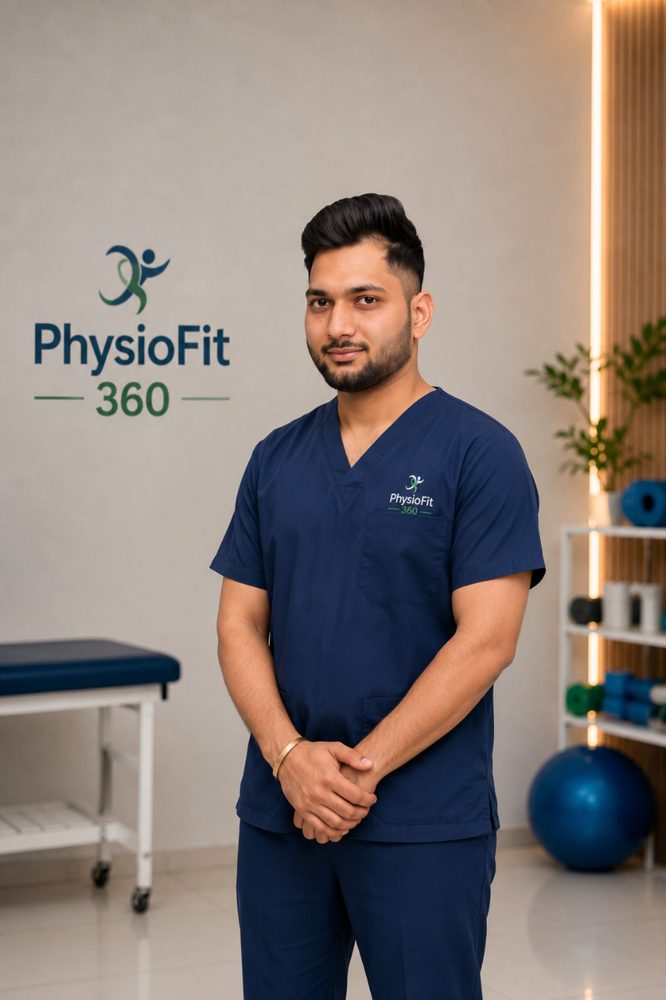
Dr. Harish Bhardwaj
BPT, MPT (Neuro)
Neurological Physiotherapy & Neuro Rehabilitation
- Neurological Physiotherapy
- Neuro Rehabilitation
- Functional Rehabilitation
- Mobility
- Movement Recovery
Professional Overview
Dr. Harish Bhardwaj holds a BPT and an MPT with a specialisation in Neurology, and practises in neurological physiotherapy and neuro rehabilitation at Physio Fit 360.
Neurological physiotherapy addresses movement difficulties that arise from the nervous system rather than from the joints or muscles alone. When the pathways controlling movement are affected, the resulting problems are typically about control as much as capacity: coordinating a limb, maintaining balance, initiating a step, or sustaining a movement accurately over time.
Rehabilitation in this field works largely through structured, repeated practice of functional tasks. The nervous system responds to consistent, well-targeted practice, and progress is generally gradual and cumulative. Because of this, neuro rehabilitation is usually a longer-term process measured in the recovery of specific abilities — standing steadily, walking a distance safely, transferring from bed to chair, using an affected hand for a daily task.
Mobility, balance, motor control and independence in everyday activities are the organising themes. Within the Physio Fit 360 team, Dr. Harish's stated focus is on this neurological and functional rehabilitation work.
Specialization & Clinical Focus
Assessment in neurological rehabilitation looks at how movement is produced and controlled. It commonly considers muscle activation and tone, coordination between limbs, balance in sitting and standing, walking pattern and safety, and the person's ability to perform everyday transfers and tasks. Understanding which of these is the main limitation determines where rehabilitation begins.
Mobility work is usually foundational. Before walking distance or quality can improve, a person often needs sufficient strength, stability and confidence to move safely between positions. Rehabilitation may therefore start with transfers, sitting balance and standing tolerance before progressing to stepping and walking.
Balance and coordination are addressed through graded challenges. Practice may progress from stable, supported positions to less supported ones, from static holds to movement, and from single tasks to tasks combined with another activity — since real life rarely allows full attention to balance alone. Safety is managed carefully throughout.
Motor control and strength are trained together. Weakness and poor coordination often coexist, and improving one without the other tends to limit functional gain. Task-specific practice — repeating the actual movement a person needs, with appropriate support and gradual reduction of assistance — is a central method, because it trains control in the context where it will be used.
Progressive rehabilitation in this field means adjusting difficulty in small, deliberate steps and repeating practice consistently over time. Goals are typically framed around independence in daily activities. Recovery varies considerably between individuals and depends on the underlying neurological condition and medical care; physiotherapy supports functional progress and works alongside, not instead of, the treating medical team.
Areas of Clinical Focus
Neuro Rehabilitation
Structured, repetitive practice of functional movement to support recovery of control. Progress is generally gradual and reviewed over time.
Mobility & Walking
Work on transfers, standing tolerance, stepping and walking safety. Aims to expand what a person can manage independently and securely.
Balance & Coordination
Graded balance challenges progressing from supported to less supported positions. Includes combining balance with other tasks as ability allows.
Motor Control
Task-specific practice to improve the accuracy and consistency of movement. Assistance is reduced gradually as control improves.
Strength & Endurance
Progressive strengthening alongside control work, since weakness and coordination difficulty often occur together. Supports sustained daily activity.
Daily Independence
Rehabilitation aimed at everyday tasks such as transfers, dressing and household activity. Practised in realistic, functional forms.
Rehabilitation Needs This Specialty Addresses
- Mobility Rehabilitation
- Balance & Coordination
- Functional Movement
- Motor Control
- Strength & Conditioning
- Independence in Daily Activities
- Neurological Rehabilitation
Rehabilitation Goals
Rehabilitation goals in neurological physiotherapy are almost always functional and highly individual. Early goals commonly involve safe movement between positions — sitting balance, standing with support, and transfers — because these underpin nearly every other activity.
As stability improves, goals typically extend to mobility: standing for longer, stepping with better control, walking greater distances, and managing surfaces or stairs where appropriate. Balance and coordination goals accompany these, since safety during movement is a priority throughout.
Motor control goals focus on performing a movement more accurately and consistently, often through repeated task-specific practice with gradually reduced assistance. Strength and endurance goals support this, allowing gains to be sustained across a full day rather than a single session.
The overarching goal is usually independence in daily activities — managing more of one's own routine with less assistance, and doing so safely. Progress in neurological rehabilitation is gradual and varies considerably between individuals depending on the underlying condition and medical care, so goals are reviewed and revised regularly.
Who May Benefit From This Area of Physiotherapy?
Neurological physiotherapy is generally relevant to people undergoing rehabilitation for movement difficulties related to the nervous system, alongside the care of their treating doctor.
- Individuals undergoing neurological rehabilitation
- People working on mobility and walking ability
- Individuals working on balance and coordination
- People seeking support with functional movement and transfers
- Individuals working towards greater independence in daily activities
- Families and carers seeking guidance on supporting movement practice safely
Approach to Physiotherapy
Neurological rehabilitation is guided by function. Goals are set around the activities a person and their family identify as most important, because those are the tasks worth the substantial practice this field requires.
Practice is task-specific and repetitive by design. Improvement generally comes from consistent repetition of the movement itself, with support adjusted so the task is challenging but achievable. Progression is made in small steps, and safety is considered at every stage.
Participation from the individual — and often from family or carers — is essential. Because progress depends on frequency of practice, part of the work involves helping the household understand how to support movement safely between sessions.
Review is continuous. Plans are adapted as ability changes, and rehabilitation is coordinated with the person's medical care rather than pursued in isolation. Expectations are discussed openly and realistically: recovery in this field is gradual, individual, and never guaranteed.
Why This Specialty Matters
Movement difficulty of neurological origin affects far more than mobility. It influences whether a person can manage their own routine, participate in family life, and maintain the independence that underpins wellbeing and confidence.
Neurological physiotherapy matters because it works patiently and specifically on the abilities that restore that participation. Improvements that may look small in clinical terms — standing steadily enough to reach a cupboard, walking safely to another room, managing a transfer without help — often change daily life substantially.
It also matters for safety and for the long term. Better balance and control reduce risk during everyday movement, while maintained strength and mobility support the ability to keep practising. For individuals and families alike, structured rehabilitation offers a clear, realistic way forward.
Part of the Physio Fit 360 Team
Working inside a multidisciplinary physiotherapy clinic means a patient is never limited to a single perspective. At Physio Fit 360, physiotherapists with different areas of specialisation — manual therapy, sports rehabilitation, orthopaedic care, neurological rehabilitation and general physiotherapy — practise under one roof in Sector 22B, Chandigarh. That shared environment makes it easier to match a person with the clinician whose focus best fits their rehabilitation needs, and to discuss a case collaboratively when a recovery journey touches more than one area. It also supports continuity: assessment, progression and review happen in the same place, with the same standards of care and communication. For patients, the practical benefit is straightforward — specialised attention within a team that understands rehabilitation as a shared, structured process rather than a series of isolated appointments.
Meet More of Our Team


Ready to Take the Next Step?
Connect with the Physio Fit 360 team to discuss your physiotherapy and rehabilitation needs.